Old St. Andrews

Main

Title

Bartholomeu Odonohue - Railwayman

Content

Item

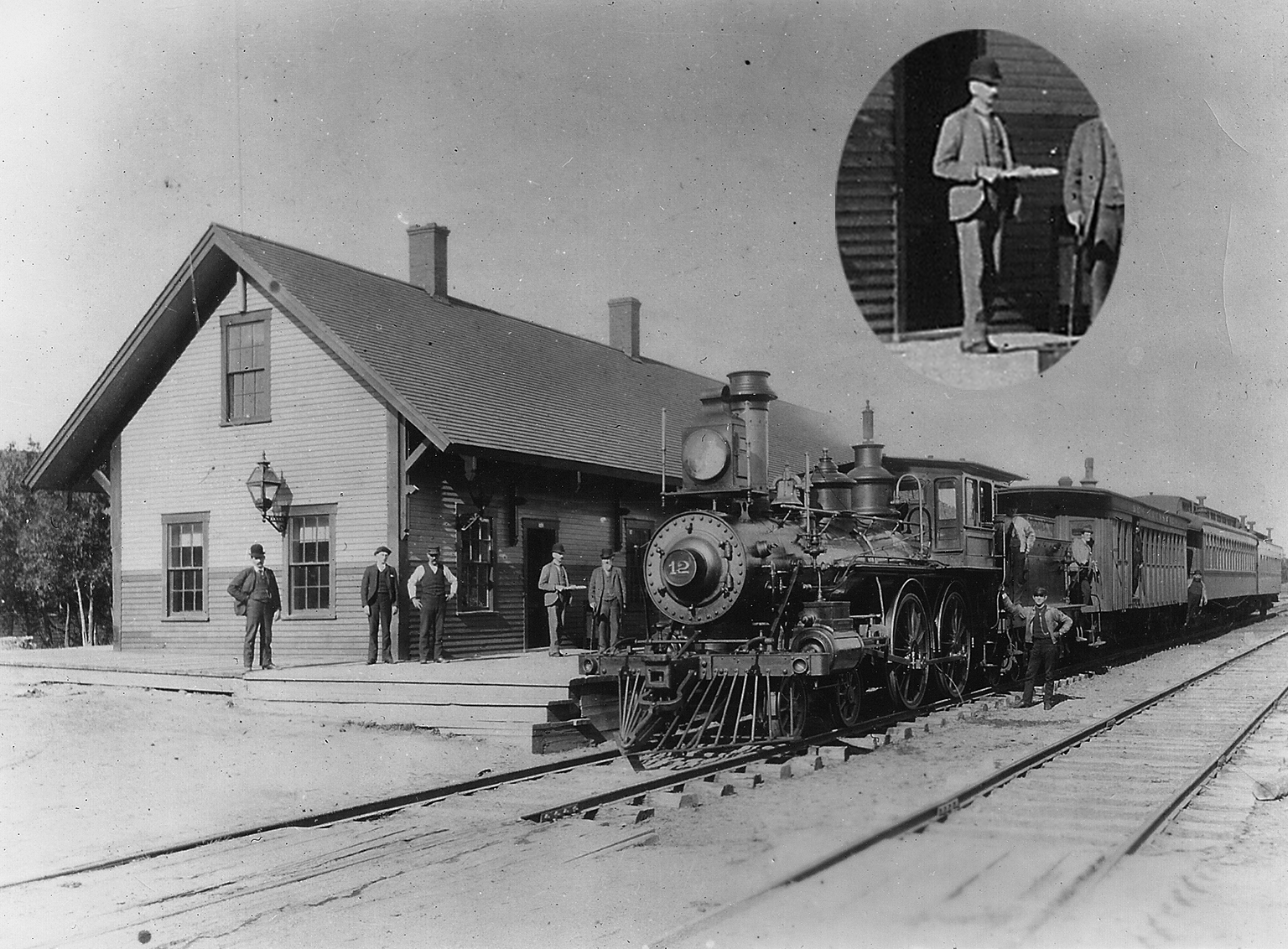
Image Photo Charlotte County Archives

St. Croix Courier

Aug 2/1945

Last Word in Locomotives—50 Years Ago

By J. F. Worrell

Science and mechanics have made wonderful strides since the above picture of old No. 12, resting proudly at the depot in St. Andrews, was taken 50 odd years ago. This funny looking old engine was one of the best on the road at that time and, so elaborately and intricately designed, was thought to be the last word in railway steam engine construction. Before reading further, if you are an old-timer from the Shiretown, try to identify the bystanders. Here are the name of most of them: from left, 1) Albert Storr, brakeman; 2) Colin Carmichael, plain citizen; Fred Stinson, baggage master; Frank Barnard, station agent; the bewhiskered gentleman, name unknown, was track master; standing at the cab door, Richard Davis, senior engine driver; on the ground, supporting the frail machine with his strong right arm, is John Davis, fireman; on the front end of the baggage car are grouped the passengers; at the side door is Bat Donahue, conductor; and on the steps between the cars, Thomas Richardson, engine cleaner.
Item

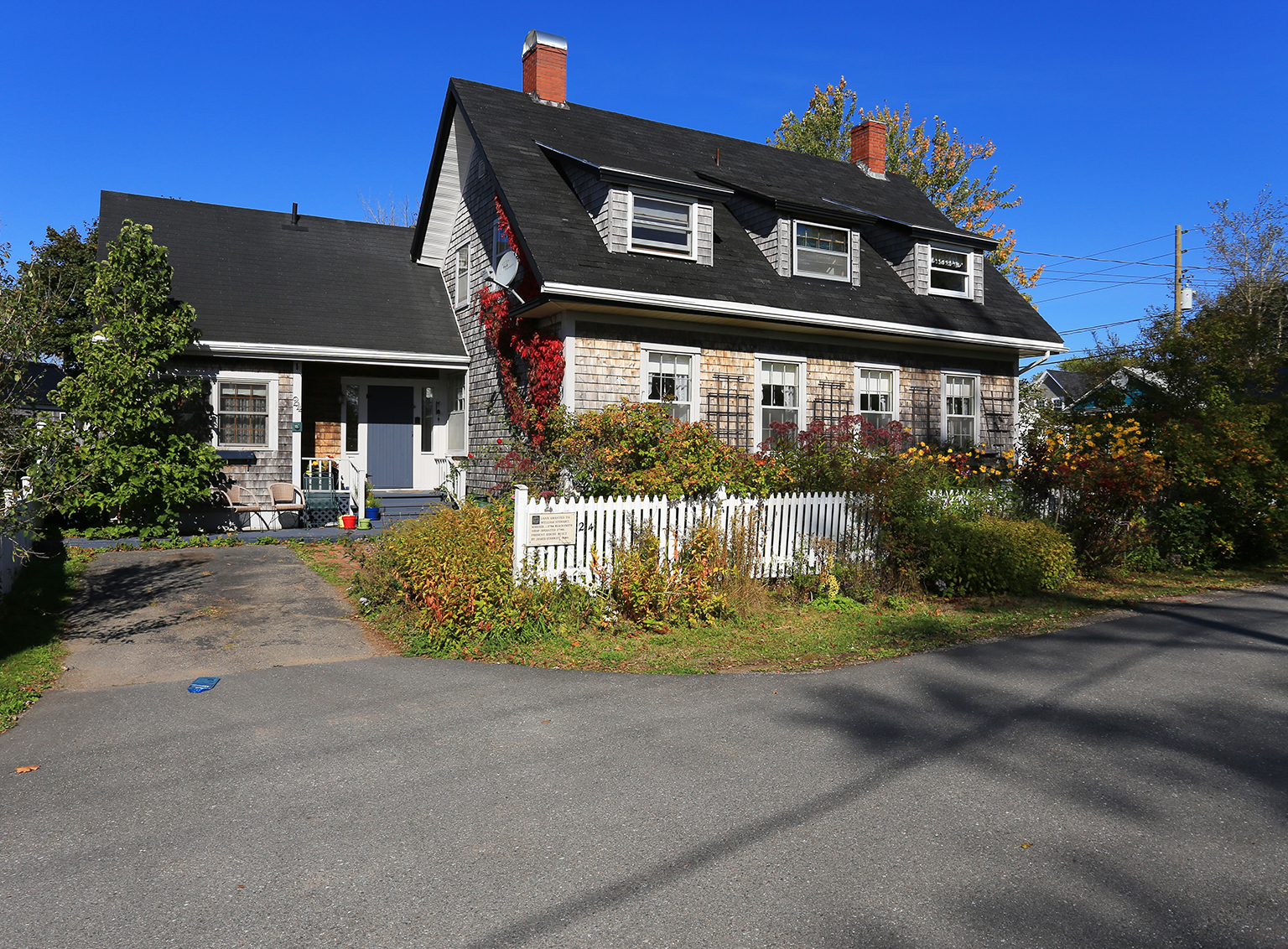
Image Home of Bartholomeu O'Donohue, 24 Augustus St. Photo David Sullivan

Item

Beacon
March 24/1892
An Old Railway Man
How long have you been railroading? asked the Beacon of Bart Donaghue, of the St. Andrews branch the other day.
            The conductor smiled. “I’m almost ashamed to tell you,”said he. “I’ve been at it so long. Years before the line was opened through from Saint John to Vanceboro I ran an engine on this road. There was no junction at McAdam then and we ran to the end of the road at Richmond.”
            “Of course, you’ve had your share of hair-breadth escapes?”
            “Well, I can’t say that I’ve had a great many. I’ve seen some pretty stirring incidents, however. In the early days, accidents were more common than they are now, and I’ve witnessed some pretty tough sights. I once had the misfortune to run over a man and until the day I die, I will not forget the terrible reaction I experienced as the engine struck him. I had been in St. Stephen. As we went in, I noticed two drunken fellows staggering along the track, but as they managed to keep clear of me, I soon forgot about them. Coming out of St. Stephen my attention was called to something on the track. At that time round sleepers were much in use, and the loose bark from them very often deceived me. When my eye first caught the object, I jumped to the conclusion that it was a piece of bark which the wind had blown off one of the sleepers, but, on nearing it I was horrified to see that it was the figure of a man who was evidently asleep. One arm was lying right across our path. I tried as best I could to stop the train, but it was a heavy one, and in spite of all I could do it rolled over the poor fellow. Up to that time I had kept my head out of the cab, vainly hoping that the noise of the train would awaken the sleeper, but when I saw all hope was past, I could look no longer. When we stopped and picked the poor unfortunate up, I saw that it was one of the drunken men that we had passed going in. His arm was taken off, and the poor chap afterwards died. His chum we found on the other side of the rail, just out of reach of the wheels.
            One incident of my early railroading days that I had forgotten,” continued the conductor, “was recalled the other day by a paragraph in the Beacon. It was the saving of a child’s life. It happened at Canterbury. I was running past that place with my cab full of passengers—passenger cars were few at that time and many people travelled on the engine—when a little child came out of a house nearby and sat down on the track. I was running pretty fast, and knowing that I could not stop before the child was reached, I scrambled out of the cabin, ran along the fool-board, and snatched the little one from the track just as the wheels were about to pass over it. It was pretty close shave and I would not like to have to do it again. The passengers were terribly excited—there was a woman or two among them—and fully expected that the child would be killed. When I lifted him out of harm’s way without a scratch on him, they were overjoyed.”
            It is possible that other interesting incidents in the conductor’s life might have been recalled had the train not come to a way station, when the conversation was brought to an abrupt close.
            There are few men in the Province who can boast of a longer and cleaner railroad record than can Conductor Donaghue, but as his is not given to blowing his own horn, the outside world knows little about him. But his employers and the most who travel with him know that he is one of the most faithful and efficient men on the road.


Beacon
Feb 22, 1894
Fighting the Snow Drifts
The Lot of a Railroad Man far From Being a Happy One
No gladiator of ancient days ever fought a sterner fight than the railway men have been fighting with the snow drifts and the boreal blast during the last few months.
            One of the toughest battles was waged at this end of the route on Friday last, when the men had to contest their way through drifts twelve feet and more high, and varying in length from twenty feet to a quarter of a mile.
            The St. Andrews train, due to leave at 7 o’clock, started away from the station a few minutes after the appointed hour. There was a plough ahead of the engine, and but one car behind, yet six hours were consumed before the train was able to reach Katy’s Cove bridge, not two miles from the depot.
            A representative of the Beacon paid a visit to the train at noon. The train crew had just succeeded in fighting their way through Heenan’s cut, where the snow was about fifteen feet deep, and the engine had backed up to the yard to take in a fresh supply of water.
            While the engine was being refreshed, the weary shovellers were feasting on bread and cheese and “hard tack” in the car behind, cracking jokes and wondering where the next stop was to be made. The fireman had not such an easy time as they for, covered with smoke and snow and grime, he was thrusting great shovels of coal into the seething furnace until the steam gauge was dancing like a thing of life, and every bolt and seam in the boiler was straining with the terrible pressure.
            The tanks having been filled, the veteran conductor, Bart Donaghue, who has waged many a battle with the element during his thirty and odd years railroad experience, gave the word to “go ahead.” Engineer Logan pulled the throttle wide open, while his assistant, Will Davis, kept piling the coal into the greedy furnace. The great machine, although handicapped by the ponderous plough in front, gave a leap forward, and swaying and rocking from side to side like an intoxicated being, dashed toward the next drift at the rate of sixty miles an hour almost. There was probably three quarters of a mile of clean track between the two drifts. Over this the engine flew a whirlwind gait.
            In an instant almost the plough struck the drift, and in the same instant inky darkness enveloped the train. On board the panting engine not an object was to be seen, not a word was spoken. Nothing could be heard but the throbbing of the struggling machine, and the swish of the snow as it flew past in a blinding tempest. The engineer clutched the lever with a grip of desperation, not knowing whether the next instant he would be plunging to his death or whether he would be brought to standstill in the snowy depths.
            In the car behind, every man was on the alert. “Will she go through?” queried an anxious one. “No, she can’t do it,” was the almost sad reply.
            For a second or two not a word was spoken. The engine kept thrashing and pounding along, and the snow rose in great clouds all around her. Her speed slackened for a moment, and as if sympathizing with the machine in her gallant struggle, the spirits of the men began to flag. But it was only for a moment, for in a twinkling the speed increased, the golden sunlight shed a flood of light around the snow enveloped train, and everyone knew that another victory had been won. The engagement was a short one, but it was thrilling while it lasted and sent the blood coursing through one’s veins at race-horse speed.
            After getting clear of the drifts between St. Andrews and Chamcook, little difficulty was experienced the remainder of the way to Watt Junction. The junction was reached at 5 pm, almost simultaneously with the arrival of a” double header” and plough from St. Stephen.
            It was three o’clock on Saturday morning before the St. Andrews train got back to the depot here.
            On Saturday, in consequence of the snow blockade, the St. Andrews engine had to run into St. Stephen. Within a couple of miles of St. Stephen, she got stuck in a snowdrift, and while pounding her way through sustained some damage. It was 2:30 Sunday morning before it was reached, and 11 o’clock the same forenoon when she ran in here with her passengers.


Beacon
Feb 5/1903
First Pensioner of the CPR
Under the above heading, the Montreal Star published a portrait and the following sketch of Conductor Bartholomew Donahue, of St. Andrews:
            Conductor Donahue, or as he is better known by his railroad associates, “Batty Donahue,”—started life in the little town of Bandon, County Cork, Ireland. If he lives until the second day of next September, he will have reached his 70th year. His ruddy, honest countenance, vigorous form, and elastic step show little indication of time's decaying hand. When “Batty” was three weeks old he crossed the Atlantic with his parents on the sailing ship Hibernia. After a stormy passage, of which, by the way, he has little recollection, the ship moored in St. Andrews harbour, and “Batty” began life as a Canadian.
            He was not 20 years of age when he entered upon railroading, his first work being as an assistant for Engineer Fosdick and Turner, who were surveying the route for the proposed railway form St. Andrews to Quebec, which was to make St. Andrews the winter port of Quebec. This was the first line of railway to be projected in the Lower Provinces, if not in all Canada. The surveying party got as far as Bartlett’s, ten miles from St. Andrews, when financial and other trouble caused a suspension of the survey, and Donahue found his occupation gone. A year or more afterward he resumed work as one of the construction hands on the new road. A month of that class of work was sufficient for him. About 1857 he became engine cleaner on the road. He remained at this post for a year, when he went firing on the Earl Fitzwilliam, the first locomotive to be brought into the Lower Provinces from the United States. Earl Fitzwilliam was one of the leading stockholders of the new railway; hence the locomotive’s name. It was a small wood-burning engine of 25 tons and would be a pigmy alongside the ponderous ten wheelers of today. At that time, it was considered quite a machine. Young Donahue fired for two years, during which time the company had added locomotives called the Rose, Shamrock, Thistle, and Manners Sutton, the latter in honour of the then Governor of the Province of New Brunswick. Batty’s first experience as driver was in 1860 or thereabouts, when he took the Thistle’s lever, she being then engaged on construction work for contractors Walker and Johnson. At that period passengers and freight trains were running to Canterbury from St. Andrews. After a year’s work with the contractor, the young engineer entered the cab of the Earl Fitzwilliam, to drive regular trains for the company. He worked the lever on two or three different engines during the succeeding ten years. Afterwards he drove for two years an engine on this branch, which was then being operated independently of the St. Andrews line. Upon the resignation of conductor Julian in 1872, Mr. Donahue left the cab and became a conductor. This position he has held without interruption ever since. He had many interesting experiences in the early days, but perhaps no more than fall to the general lot of the railway man. The Railway Corporation for which he first worked was known as the St. Andrews and Quebec Railroad Company. Then the name was changed to the New Brunswick and Canada, afterwards to the New Brunswick and more recently the CPR.
            Mr. Donahue has served all his masters faithfully and well, his first concern always having been the interest of his employers and the safety of the lives entrusted to his care. It was this trait in his character that was for him the esteem of his employers and the confidence of the travelling public. Mr. Donahue is a widower, with two sons. One of his sons is station agent on the Bangor and Aroostook Railway, the other is a machinist in the Boston Electric Works. At present Conductor Donahue is enjoying a few months leave of absence, which he is making the most of, though when will be eligible for retirement in July, he will probably continue as conductor of the summer trains for a time.


Beacon
July 24/1902
Bar Road Tragedy Inquest Begins
[death of Robert Stevenson, contractor, builder of the Algonquin Hotel and many other structures and homes in the area - Ed.]

Robert Purton was the first witness. He deposed: “I am an engine-driver on the CPR. Have been driving since 1881. Knew the deceased. Saw him seated in his carriage at Bar road crossing. Was about 30 feet from him when he saw him. It was about 11:00 o’clock am on Wednesday, July 16. Engine was running about six miles an hour. Made emergency application of air brake the moment I saw deceased. The brake did not stop the engine quickly enough to prevent the man from being struck. The engine, he thought, struck the carriage in the middle. Saw the carriage going to pieces. Did not see the horse. He was on the other side. there was no stop to be made at the Bar Road platform. Don’t know when train left Chamcook. Train was 15 minutes late, but was not making up time. A man’s horse would be on the crossing or pretty handy to it before a team could be seen by the engineer. Never had any trouble at this crossing before. Am always careful at this crossing—more so than any other crossing. It is a flag station, hence the care. There are slow boards a quarter of a mile on each side of Bar Road crossing. That board means to reduce speed. Usually reduce to about 6 miles an hour. We give one long whistle about a mile from the crossing, and two long and two short whistles at slow board and whistling post. They are both together. The slow board and post are about a quarter of a mile from the crossing. From this we gradually slow down until crossing is passed. The bell is kept ringing almost from the whistling post until the crossing is reached. On the day of the accident, he blew engine whistle a mile from the crossing; also blew at slow board. The bell was rung by fireman. The whistles were distinct. Don’t know why whistles and bell could not be heard by a man approaching the crossing. With such protection as the railway affords, I consider the Bar Road crossing safe. I saw the deceased he was sitting in his carriage in a stooped position. He never turned his head one way or the other. Could not say whether he was asleep or not. So far as I could see he never varied this position. He seemed to be in a deep study. Did not look as if he realized the danger of his position.
            Bartholomew Donahue: “Have been a conductor at least 25 years. Was in charge of morning train July 16. We behind time that day about 15 minutes. We made up some of the time between Watt Junction and Bar Road. Were running on an average 25 miles an hour. Do not call this a high rate of speed. Everything was in perfect order in connection with this train that morning. We use the air brake on this train. It is a perfect invention. The train would run the length of two or three cars before being stopped by the air brake. I don’t think a train going at the rate of 6 miles an hour could be stopped short of the length of two cars on down grade. We blew our first whistle after we left Chamcook station. Next whistle we blew at whistling post. At the whistling post the rate of speed was about ten miles an hour. I heard bell ringing as we were coming to the crossing; it rang until we struck the team. I was looking out of the baggage car door as train was passing the Bar road crossing. I saw a team on the very of the track. I saw part of horse and buggy. I saw the buggy over the side of the train. Two or three seconds of time elapsed during the period of collision. There was no time to signal or make any effort to save the man. I jumped off the train to see the results. I saw a man lying dead on the ground and horse killed on the other side of track. I did not know the man at first. Did not examine the body carefully. It is very seldom any accident happens on this end of the road. There are ten or twelve crossings between here and Watt Junction. We have printed regulations regarding whistling and ringing of bell at these crossings. The Bar Road crossing is distinguished by having extra precautions taken. The extra precaution is to go slow—not more than six miles an hour. It is a very slow rate. Think the horse was trotting when I first saw the carriage on the verge of the track. I don’t think the horse could have been pulled up if the deceased had seen the train at the time I first saw it. I consider the Bar Road crossing, from its position, a dangerous one—the most dangerous one between here and Watt Junction. Don’t remember having nearly collided with something on this crossing. The train went three car lengths before being stopped. We had five cars on. It would not have been possible to avoid the collision had the train been running three miles an hour. Have received special instructions about Bar Road. Last order was about a year ago. We were not to exceed six miles an hour.


Beacon
June 2, 1917
Bartholomew Donoghue
On Wednesday morning May 23rd, Mr. Bartholomew Donoghue was found dead in his bed, at his home on Augustus Street, by a neighbour who went to make a friendly call.
            The late Mr. Donoghue was one of the old landmarks of the St. Andrews, and his name and works were closely associated with the earliest days of railroading from this town. He was born in County Cork, Ireland, in the year 1833, and came to Canada in 1836. He began his career as a railroad man in 1856, and from the humble position of engine cleaner, he rose to be one of the most trusted and most popular of the railroad conductors, first on the New Brunswick and Canada Railway, and afterwards on the New Brunswick Railway and finally on the CPR. For sixteen years he most successfully and skillfully held the throttle as an Engine driver, and for thirty years he served his employers most faithfully as a train conductor, and with that degree of courtesy which won for him the esteem and respect of the travelling public who had occasion to pass to and fro on the trains of which Mr. Donoghue had charge.
            In the year 1904, after Mr. Donoghue had passed his seventieth birthday, he accepted from the railway company his retiring allowance, and has spent his life from then until the time of his death in the rest and quiet of his own home.
            The late Mr. Donoghue was married to Catherine Driscoll, and five children were born to them, three sons and two daughters, of whom William John Donoghue, of Herman Station, Maine, a trusted and expert telegrapher, in the employ of the Railway, and Bartholomew Benedict Donoghue, his twin brother, now in the employ of the Metropolitan Street Railway Company, of Boston, are the only survivors.
            The deceased was 84 years of age at the time of his death, and his long life had been a striking example of honesty and industry. His remains were laid at rest in the Roman Catholic Cemetery on Saturday last, and the large attendance of citizens xat the funeral showed the esteem in which the deceased was held in the town where he had spent nearly all of his long life.